

Is It Really Plantar Fasciitis? Or Could It Be Something Else?

Heel pain is one of the most common foot complaints, and plantar fasciitis is often the go-to diagnosis. But there’s another condition that can feel almost exactly the same — and can be harder to treat if it's not properly identified — and that’s Baxter’s nerve entrapment.
Let’s take a look at how these two conditions differ, and why it matters.
A Quick Refresher on Foot Anatomy
To understand these conditions, it helps to revisit a bit of anatomy.
The plantar fascia is a thick, fibrous band of tissue that runs from the heel bone (calcaneus), specifically from the inside (medial) part, and stretches along the arch of your foot to the base of your toes. It acts like an elastic band — helping support your arch and store energy with each step.
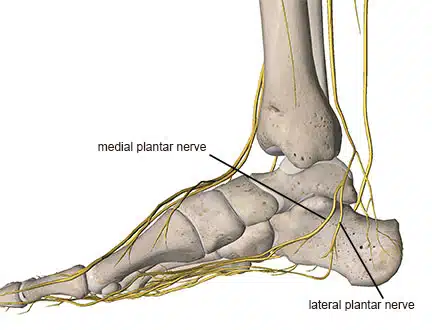
Now enter Baxter’s nerve. This is a branch of the lateral plantar nerve, which itself comes from the tibial nerve — the same nerve that runs down behind your inner ankle. The tibial nerve splits into medial and lateral plantar nerves, which supply the muscles and skin of the sole.
Baxter’s nerve is the first branch of the lateral plantar nerve, but it runs along the inner side of the heel — near the same area where plantar fasciitis pain is often felt. It travels between two muscles — the abductor hallucis and the quadratus plantae — and this is where it can become compressed or "entrapped."
So What Causes the Pain?
Plantar Fasciitis
This condition is usually due to overuse of the plantar fascia, leading to tiny tears and degeneration at the heel attachment. Contrary to popular belief, it’s not very inflammatory — it’s more of a degenerative issue.
Pain is often sharp and intense with the first step in the morning, or after long periods of rest.
It tends to ease with light movement but can worsen with prolonged standing or activity.
The pain is focal — usually felt on the inner part of the heel.
It rarely involves burning, tingling, or radiating pain.
Baxter’s Nerve Entrapment
This is caused by compression of the nerve between nearby muscles and bone, often made worse by:
-
Flat or pronated feet
-
Tight surrounding muscles
-
Chronic thickening of the plantar fascia pressing on the nerve
Symptoms can include:
-
Burning, tingling, or radiating pain
-
Pain that worsens the longer you're on your feet
-
Sometimes pain at night, unlike plantar fasciitis
-
Occasionally, weakness in moving the 5th toe out to the side (loss of abduction)
How Do We Treat Them Differently?
While both conditions involve heel pain and may be managed similarly at first, there are important differences in how we treat them effectively.
Shared Strategies
-
Reducing strain on the heel (e.g. supportive footwear, taping, or orthotics)
-
Modifying activity levels
-
Stretching and strengthening exercises (depending on condition)
-
Footwear advice and relative rest
Key Treatment Differences Between Plantar Fasciitis and Baxter’s Nerve Entrapment
For plantar fasciitis, the focus of rehabilitation is on progressive loading to build strength and improve the tissue's ability to handle stress. In contrast, for Baxter’s nerve entrapment, the aim is to unload the nerve and reduce compression, particularly in the medial heel area.
When it comes to stretching, it is not usually a priority for plantar fasciitis, though some targeted fascia-specific stretches may be helpful. On the other hand, in Baxter’s nerve entrapment, gentle stretching, mobilisations, and self-massage techniques can help to relax the tight muscles that may be compressing the nerve.
Orthotics also play a different role in each condition. For plantar fasciitis, arch support and heel cushioning are used to reduce tension on the fascia. For Baxter’s nerve entrapment, softer orthotics that reduce pressure on the inner heel tend to be better tolerated and more effective.
Corticosteroid injections are used cautiously in plantar fasciitis, as repeated use may weaken the fascia and cause complications. However, when dealing with Baxter’s nerve entrapment, a targeted steroid injection near the nerve — particularly under ultrasound guidance — can be much more beneficial in reducing inflammation and irritation.
Nerve glides are not typically relevant in the treatment of plantar fasciitis. However, for Baxter’s nerve entrapment, tibial nerve glides can be helpful in restoring mobility and decreasing nerve irritation.
What’s the Takeaway?
In short:
-
Plantar fasciitis responds well to gradual loading and strengthening.
-
Baxter’s nerve entrapment responds better to unloading, soft tissue work, and reducing compression — especially in the early stages.
Misdiagnosing Baxter’s nerve entrapment as plantar fasciitis can lead to the wrong treatment plan, which may actually make things worse.
Summary: Don’t Assume It’s Just Fasciitis
Not all heel pain is caused by plantar fasciitis. Baxter’s nerve entrapment is a common — but often missed — cause of medial heel pain.
If:
-
You don’t get first step pain
-
Your pain is burning or tingling
-
It worsens with time on your feet or at night
-
And you’re not improving with a typical loading rehab plan…
Then you might be dealing with a nerve issue, not just fascia.
If you’re not sure what’s causing your heel pain, it’s always best to get a thorough assessment from a qualified health professional who can help you identify the true source of the problem — and guide you toward the right treatment.